

This article argues that Canada’s so‑called “Lost Liberal Decade” was not a period of drift or mismanagement, but a deliberate strategy to collapse private investment and normalize and gain social acceptance of federal ownership of energy infrastructure —laying the groundwork for a debt‑financed nationalization agenda or centrally planned economy, disguised as patriotic nation‑building.
Recent announcements by Ottawa, together with the Alberta and Ontario provincial governments, that two major pipelines, funded by tax-payers, were advancing to a permitting phase, got me questioning everything that I thought was the basis of the Lost Liberal Decade.
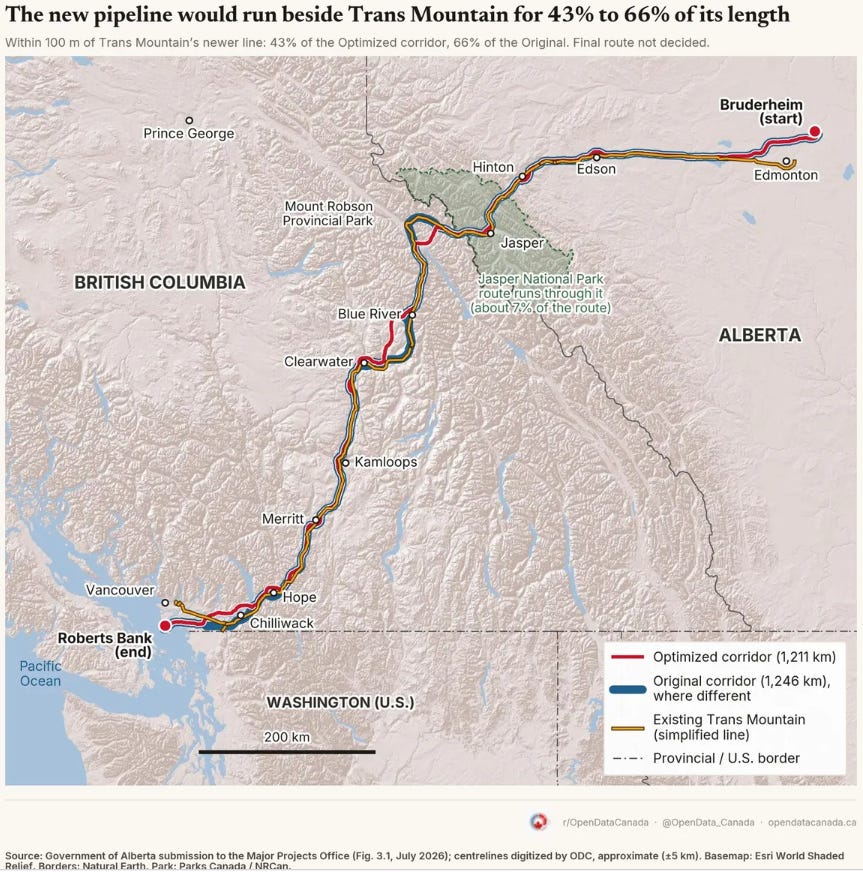
These projects are the Pacific Link and Northern Shield pipelines.
Pacific Link, formally the West Coast Oil Pipeline, is a proposed 1 million barrel per day (bpd) bitumen line from Alberta to the British Columbia coast along the existing federally owned Transmountain pipeline route that avoids the North Coast. It was formally listed as a project of National Interest on 1 October 2026, with development led by the federal crown corporation Trans Mountain Corporation (TMX) and Pembina Pipeline as a minority private investor.
Canada and Alberta will hold equal ownership, while Indigenous communities will be offered a minimum 10 percent interest, financed through the federal and Alberta loan guarantee programs.
Current specific capital cost estimates run from $35 to $44 billion per million bpd or $35,000 to $44,000 / bpd, which is lower than the recently commissioned federally owned TMX 2.0 pipeline that settled out at $58,500 / bpd.
Note that the final specific capital cost estimate of the Transmountain Expansion (TMX 2.0) prior to federal purchase, was around $12,500 / bpd - over a 4x increase in cost from purchase to commissioning.
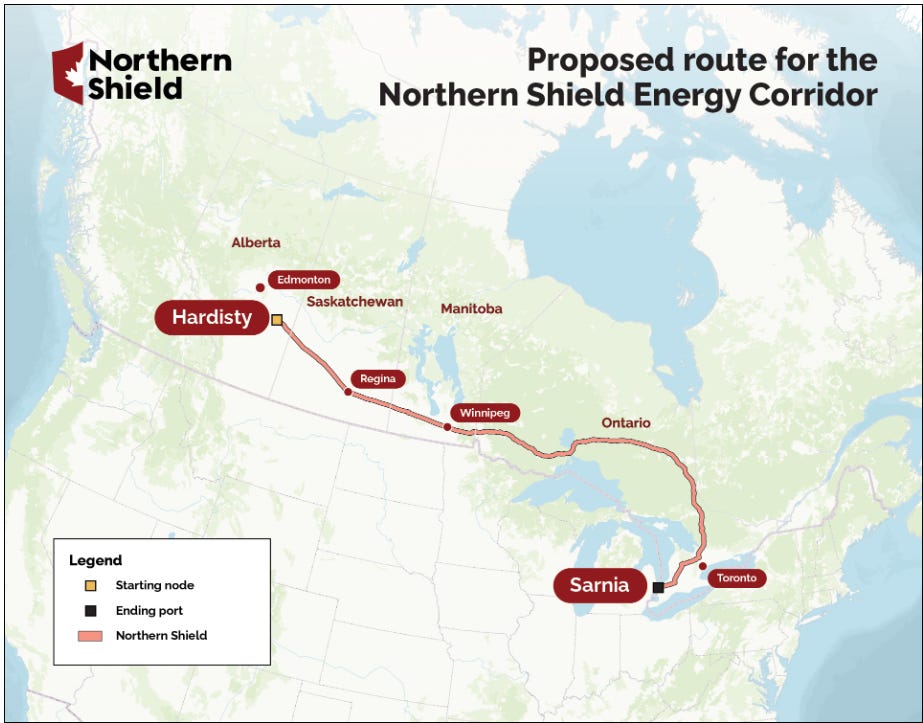
The Northern Shield Energy Corridor is a proposed all-Canadian crude-oil pipeline of about 3,300 kilometres from Hardisty, Alberta, to refineries in Sarnia, Ontario, with an initial capacity of about 500,000 barrels a day, expandable to 800,000.
Premiers Danielle Smith and Doug Ford unveiled the route on 6 July 2026, with Ontario as the leading proponent and a substantial investor supplying patient capital to start the project, and no published equity percentage.
No preliminary cost estimate for Northern Shield exists at this early stage.
The backdrop to Northern Shield is an escalating 10 year legal threat by the State of Michigan to revoke Enbridge’s permit for the 540,000 bpd Line 5, which begins in Superior, Wisconsin and ends in Sarnia, Ontario.
This real and growing risk would not exist had Ontario not stood idly by in October 2017 as the Trudeau Liberals made the legacy Trans Canada’s 1.1 million bpd Energy East pipeline from Hardisty Alberta to Saint Johns New Brunswick liable for both upstream and downstream CO2 emissions associated with the crude oil pumped through its pipeline.
On 16 January 2017 the Bad River Band of Lake Superior Chippewa in Wisconsin voted not to renew the Line 5 right-of-way across its reservation, whose easements had expired in 2013.
Note that Enbridge’s Line 5 supplies more than 50 percent of the feedstock Ontario refineries use for gasoline and other fuels, and more than 60 percent of Quebec’s crude.
With the growing rift between Ottawa and Washington D.C., Doug Ford’s Ontario government is urgently leading the charge to declare Northern Shield a project of National Interest.
In other words, a matter of National Security.
Had Ottawa not ignored the clear signs emerging from both Washington D.C. and Michigan, over both the infamously failed Keystone XL and the Line 5 projects, Central Canada would not be in such a geopolitical exposed position that it is today.
Yet here we are today and for many Albertan and Saskatchewan energy advocates, we struggle to not mockingly state, “we told you so.”
For those who are unfamiliar with Canadian history, these nationalized projects are a repeat of the failed National Energy Program, where under former Pierre Trudeau, the Federal Government created a crown corporation called Petro Canada.
Petro Canada was formed after the extended energy shockwaves of the 1970s Oil Crisis emanating from the Middle East.
This legacy State owned energy enterprise came to an end in August 2009 after 3 decades of buying high and selling low, when the private sector integrated Alberta energy giant Suncor Energy purchased its assets for $22.5 billion.
Thus, it is the failed experiment of Petro Canada that is the lense through which we should examine this renewed interest in Canadian State owned pipelines.
The fact that these 2026 announced National Interest projects have come forward without leading private sector proponents, has caused me to ask the following:
Was the Carney Liberals’ Build Canada Strong agenda the plan all along throughout the Lost Decade under the Trudeau Administration?
It is a question that sounds provocative only until you examine the decade-long pattern of political choices, economic outcomes, and institutional behaviour that brought Canada to this moment where national security is called into question.
Once you trace the arc from 2015 to 2025, the conclusion becomes increasingly difficult to avoid: the Lost Decade was not a period of drift, nor a period of incompetence, nor a period of naïve climate idealism.
It was a period of preparation for renewed energy infrastructure nationalization.
It was the decade required to starve Canada of private investment, cripple the country’s capital efficiency, normalize federal ownership of energy infrastructure, and clear the field of private-sector builders so that the Carney Liberals could step forward with a debt-financed nationalization agenda dressed up as patriotic nation-building.
Canadians were told that the Trudeau era was a time of a trillion dollar energy transition opportunity, and a necessary pause before a new economic model could emerge.
But the pause in private sector investment never ended.
Instead, private investment collapsed and according to the Royal Bank of Canada, more than a trillion dollars in capital fled the country - largely to United States.
Projects that once attracted global investors without bait or coercion, now suddenly required federal rescue.
Provinces that once built pipelines and power plants found themselves waiting for Ottawa’s permission.
And Canadians who once invested directly in Enbridge, TC Energy, and Pembina Pipelines—high-dividend, low-risk stocks that formed the backbone of middle-class retirement portfolios—were quietly pushed aside in favour of foreign sovereign wealth funds and mega-scale institutional investors.
I argue that Canadians must not accept liability for crown corporation debt without direct avenues for individual equity.
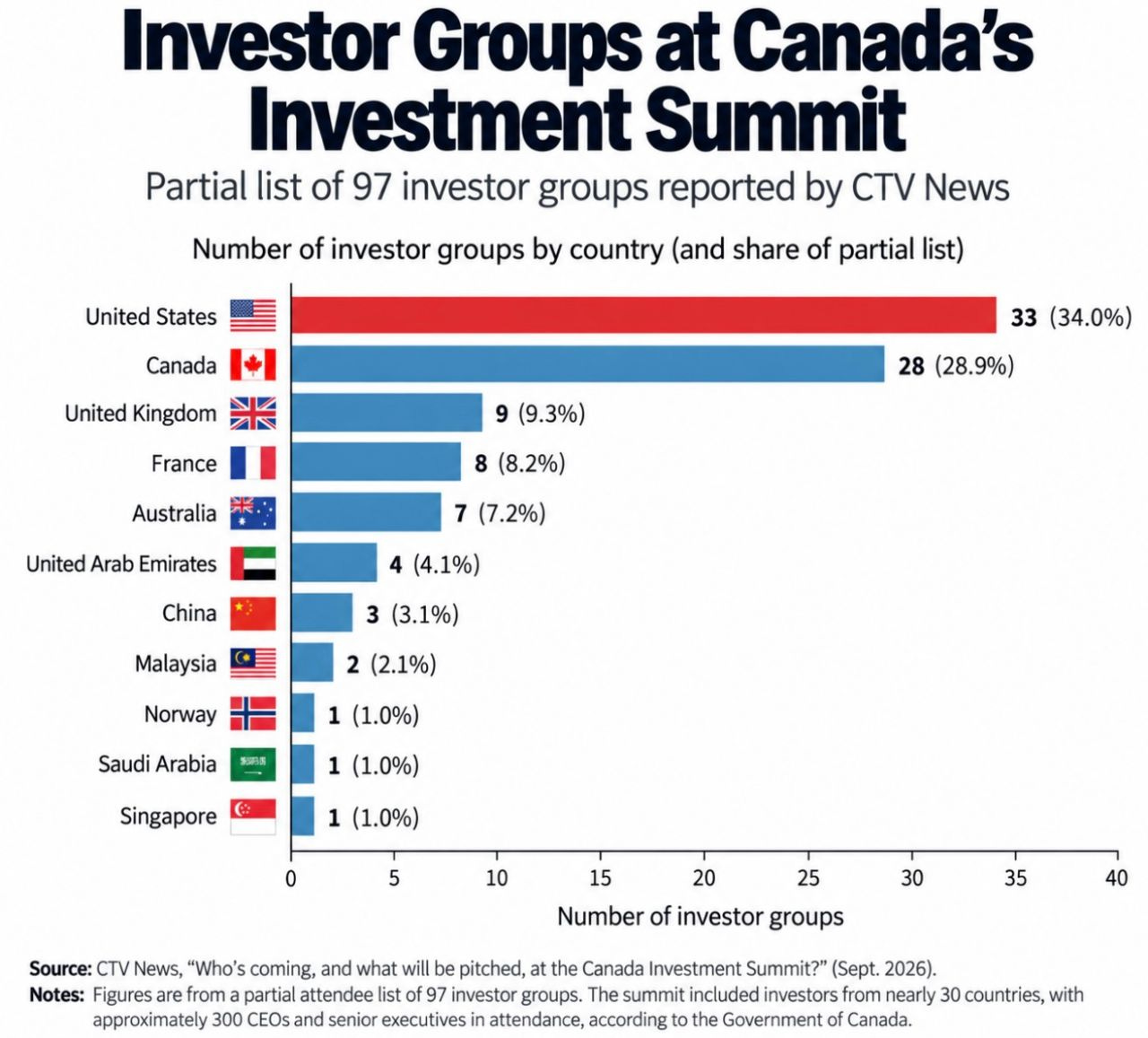
The September 14th - 15th Canada Investment Summit’s partial list of attendees, is quite telling where most of the potential capital behind the Carney Liberal’s claim to see $1 trillion invested in Canada over the next 5-years.
Ironically, the greatest number of investors were from United States.
Canadians, who built this country’s energy wealth through their personal investments and sweat equity, are being told to sit quietly while foreign interests buy the future.
The federal acquisition of TMX 2.0 was the psychological turning point.
Canadians were told it was a reluctant purchase, a necessary intervention to satisfy disgruntled Albertans.
However, the moment Ottawa took ownership of a major hydrocarbon pipeline, the barrier was broken. The idea of crown-owned pipelines, once unthinkable after the failures of Petro‑Canada and the National Energy Program, have now again become normalized.
And once normalized, it becomes expandable.
The Lost Decade created the conditions where federal ownership could be presented not as ideological ambition, but as practical necessity.
And that is precisely how the Carney Liberals have framed their Build Canada Strong agenda: not as a takeover, but as a rescue.
But why would private investors need to be replaced at all?
Why would Ottawa need to step in so aggressively?
The answer lies in the collapse of capital efficiency so severe that private investment became impossible.
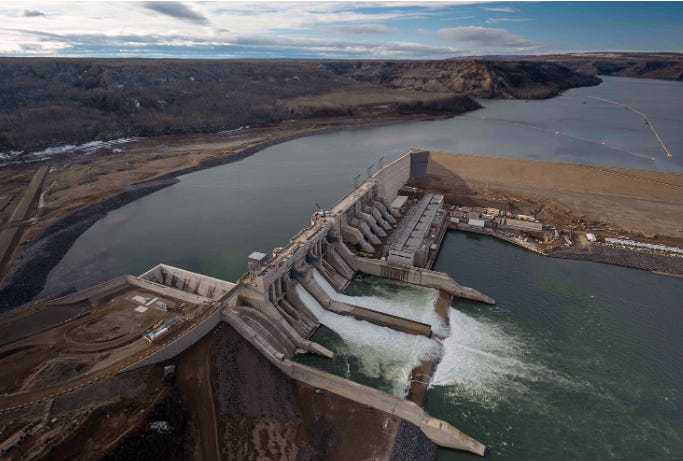
Take for example British Columbia’s recently commissioned Site C hydroelectric dam and its newly announced Northwest Transmission Line, which collectively comes in at $22,000 to $24,000 per kilowatt, more ten times the cost of modern combined-cycle natural gas turbines (CCGT) that could have easily been colocated at the LNG Canada export facility.
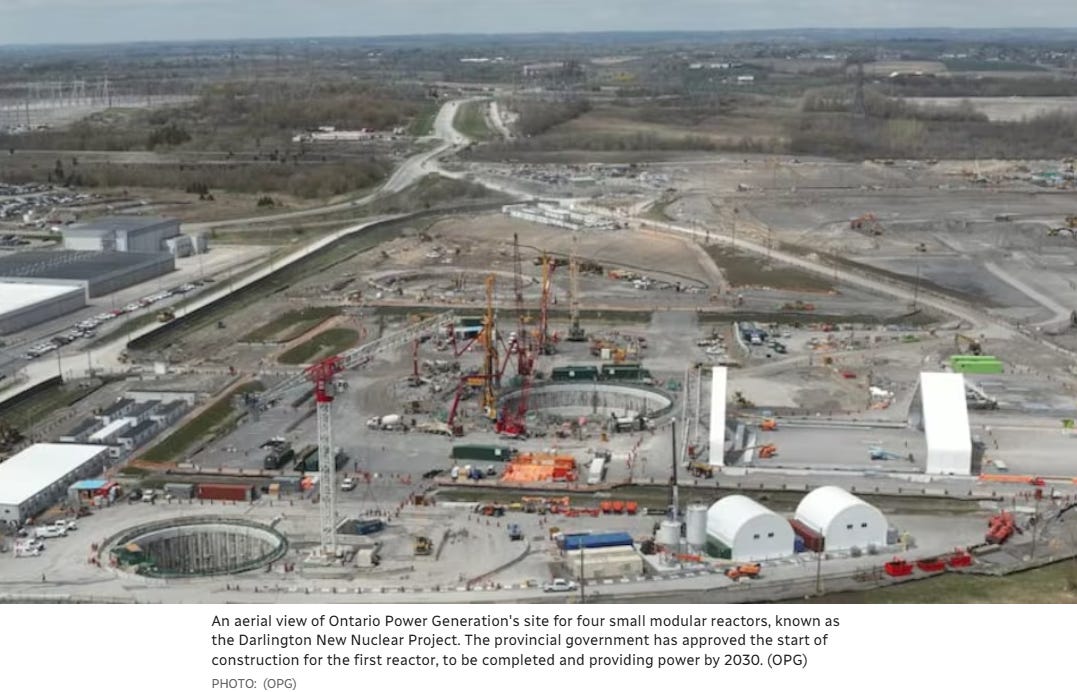
A further case in point is Ontario’s Darlington Small Modular Reactor project, which carries a specific capital cost of $13,900 to $17,400 per kilowatt, even though Ontario Power Generation already held permits for a CANDU reactor that would have had a specific capital cost roughly half as much.
Although a large CANDU reactor costs more in total dollars, it delivers electricity at a lower cost per kilowatt than SMRs and because retail power prices ultimately reflect specific capital costs, consumers pay less.
The TMX 2.0 that ballooned from $7.4 billion to $35 billion, a fivefold escalation that pushed its specific capital cost to $60,000 per barrel per day, which is nearly five times the cost of comparable U.S. pipelines.
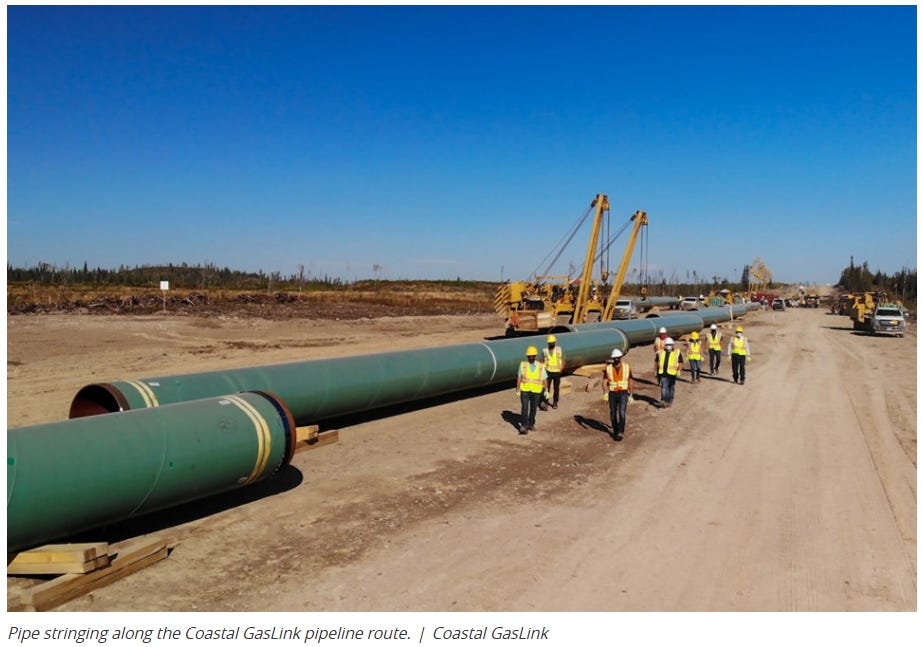
As well, the Coastal GasLink pipeline to LNG Canada’s Kitimat export terminal, doubled its specific capital cost from $3 to $7 per SCF/day, likewise far above U.S. benchmarks.
These are not isolated failures.
They are symptoms of a system designed to make private investment unviable.
When capital costs explode, rates of return collapse and private capital flees. When private capital flees, governments step in, and not because the projects are inherently unviable, but because the investment climate has been made inhospitable.
Unless we get to the root cause of Canada’s collapsing capital efficiencies, Ottawa’s new debt-financed $75 billion Sovereign Wealth Fund that aims to back-stop foreign investment capital, will be building on sand.
This latest federal investment vehicle mirrors the Canada Pension Plan Investment Board (CPP) and Brookfield Asset Management Ltd. today announced the launch of the Maple Fund, a joint cooperation framework to generate and execute up to C$50 billion in equity of large-scale investments in critical infrastructure and strategic industries across Canada.
Yes, even Canadian pensions are being used to underwrite and de-risk large institutional investors.
The Carney Liberals are not trying to fix capital efficiency, they are exploiting its collapse.
A country that cannot build infrastructure at competitive cost is a country that must rely on federal intervention, and federal intervention is the gateway to federal ownership.
Nowhere is this clearer than in the accelerating push toward the Pacific Link and Northern Shield pipeline concepts—projects that, in any normal investment climate, would be led by private-sector pipeline companies with decades of engineering, construction, and operational expertise.
But those companies are gone or rather, they have been driven out.
The Lost Decade hollowed out Canada’s pipeline sector so thoroughly that the country now has almost no private firms willing to execute large-scale hydrocarbon transportation projects.
Enbridge has shifted its capital strategy toward U.S. jurisdictions where regulatory timelines are predictable and capital costs are sane.
TC Energy has divested major pipeline assets and restructured itself to reduce exposure to Canadian megaproject risk. TC Energy now invests heavily in US and Mexico, where it is able to build projects on schedule and under budge - case in point is the Southeast Gateway Pipeline in Mexico with a specific capital cost of $4 per SCF/day compared to $7 per /SCF/day for its Coastal GasLink pipeline built in British Columbia.
The private pipeline sector did not die of natural causes, it was suffocated.
And into that vacuum steps Ottawa.
If you want to see the future of Build Canada Strong, look at Churchill Falls.
On August 17, 2026, Ottawa, Quebec, and Newfoundland and Labrador announced a $70 billion expansion package that would “nearly triple” the power generation capacity of the Churchill Falls hydroelectric facility - second largest hydro-plant in Canada by nameplate capacity.
The Carney Liberals promised to put $10 billion down on the project and the Canada Investment Summit specifically state that this project is a prime candidate for foreign investment.
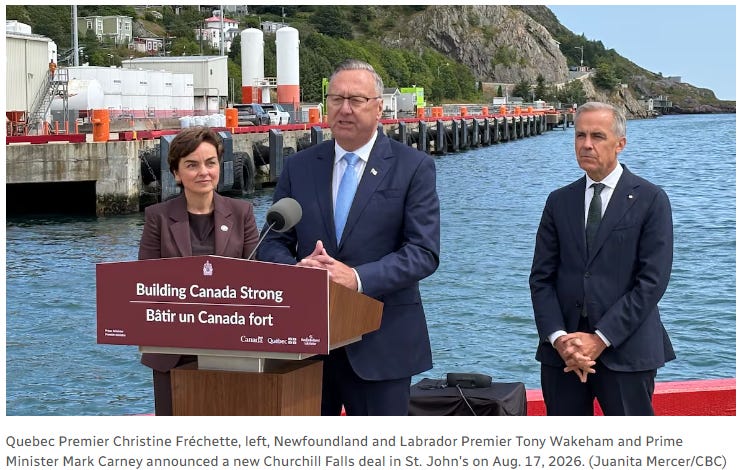
It was sold as a triumph of clean energy nation-building.
As outlined in my recent Epoch Times Op-Ed, my analysis of the Churchill Falls Plus project suggests that it will increase electrical energy production by a mere 20 TWh on top of the legacy 35 TWh of energy produced by the base case plant.
Bear in mind that in 2026 dollar, the legacy Churchill Falls power plant cost approximately $22 billion and it generates on average 35 TWh of electrical energy per annum.
This new $70 billion investment will likely only expand electrical energy output by 20 TWh per annum, while costing $70 billion.
That is not even a doubling of energy production, but a tripling of power generation capacity is a better sound bite.
This sound bite leverages the simple fact that most people don’t recall high school Physics and the difference between energy (joules) versus power (joules/s).
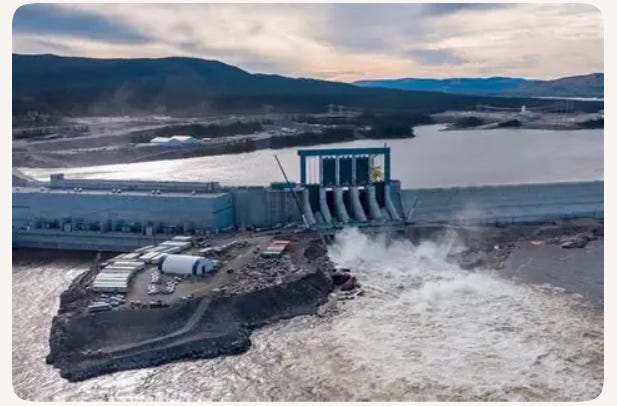
The reason being is the newly upgraded legacy Churchill Falls plant is designed to now operate as a wind-subservient hybrid peaker unit, reducing hydro output when regional winds blow strong. As a result of these design changes, Churchill Falls will no longer function as one of Canada’s highest performing baseload hydroelectric dams and its capacity factor will drop.
This is what happens when you add more turbing capacity without increasing the reservoir volume.
The real energy growth in the Churchill Falls Plus program comes from the downstream Gull Island run-of-river dam and a regionally sited 2,000 MW wind complex that are all connected on the same grid.
And the estimated retail cost of electricity will be $0.11 per kWh, which is more than double the breakeven of newer Albertan CCGT power plants.
The physics are clear and the economics are clearer, had the same $70 billion been invested in modern CCGT plants, colocated near metropolitan load centres and energized by Atlantic Canada’s untapped and immense natural gas resources, the same capital would produce over 10 times more electrical energy at half the cost.
That would require competitive capital costs.
It would require private investment.
It would require provincial autonomy.
It would require Ottawa to reject its insane Net Zero obsession.
In other words, it would require the traditional Alberta model—the model the Liberals spent a decade dismantling.
The traditional Alberta model is simple: build infrastructure at competitive cost, allow private investment, generate strong returns, use royalties and corporate income taxes to reduce the burden on households, while maintaining provincial autonomy.
It works and has worked for decades.
It has produced prosperity unmatched anywhere else in the country.
But it is incompatible with the Carney Liberals’ vision of a centrally planned economy.
The Alberta model empowers provinces, while the Build Canada Strong model empowers Ottawa.
The Alberta model enriches Canadians, while the Build Canada Strong model enriches institutional investors who investment risk will undoubtedly be socialized by tax payer debt and citizen’s public pension funds.
And so we return to the original question: was this the plan all along?
Was the Lost Decade under Trudeau—the decade of capital flight, regulatory paralysis, judicial unpredictability, ENGO veto politics, and the systematic hollowing-out of Canada’s private pipeline sector—the necessary precondition for the Carney Liberals’ nationalization agenda?
The evidence suggests it was.
Because only by starving Canada of more than a trillion dollars in private investment could the federal government create the conditions where nationalization becomes not only possible, but politically inevitable and socially acceptable.
Only by making infrastructure prohibitively expensive could Ottawa justify stepping in as the builder of last resort.
Only by pushing Canadians out of ownership could the federal government make room for foreign sovereign wealth funds.
Only by clearing the field of private pipeline builders could Ottawa position itself as the sole executor of Pacific Link, Northern Shield, and every other corridor that will define the next half-century of Canadian energy transport.
And only by building infrastructure at inflated capital costs could Ottawa ensure that revenues flow to institutional investors rather than taxpayers or citizen retail investor’s RRSP or TFSA savings, thereby guaranteeing that whatever public profits emerge, will be too small to materially reduce the tax burden on the average Canadian.
This is the quiet truth behind Build Canada Strong: it is not a nation-building program.
It is a nationalization program of a centrally planned economy.
And it was made possible by a decade of deliberate capital starvation and growing cultural desperation.
The Lost Decade was not a period of drift, it was a period of preparation.
And unless Canadians demand a return to competitive capital costs, private investment, provincial autonomy, and direct public ownership opportunities through traditional investment vehicles — the principles that built Alberta’s prosperity—they will wake up to find that the country’s economic future has been placed in the hands of foreign sovereign funds, federal debt managers, and institutional investors whose interests do not align with their own.
The question is no longer whether Build Canada Strong was the plan all along.
The question is whether Canadians will allow it to become the future?
Yes, everything the Liberals have done since 2015 has made it harder and harder for private investment, then the Liberals declare "market failure" which is nonsense, and then state the only option is for the government to borrow hundreds of billions to get it all done because dastardly private enterprise won't step up.
Its a stealth imposition of the chinese economic model, of course it is because the Liberal party is an adjunct to the CCP.
I'm in Calgary, last week after the Carney announcement i was listening to the afternoon show economic geniuses on QR77 discussing it, they talked about how there would be an open season for this pipeline next year and that if the oil companies didn't commit to new supply because costs are too high the govt would have to step up and subsidize that as well. I almost broke my laptop yelling at it.
Costs are high BECAUSE of Liberal policy, over regulation and the coming carbon tax and the utterly useless Pathways alliance. So the economic geniuses, instead of suggesting the govt reduce those costs they suggest they govt give some of that money back after taking it and laundering it thru govt.
This is why we cannot have nice things, because too many people are completely economic illiterate.
Powerful insights and context as always. Adding: I recently went back to D.V. Smilie’s work wrt phases of Executive Federalism and found it to be helpful in understanding the points you are making in a temporally broader system system level view; anchored in his thesis that federations only work where sovereign members bargain as equal partners to reach authentic policy consensus.